day of wrath

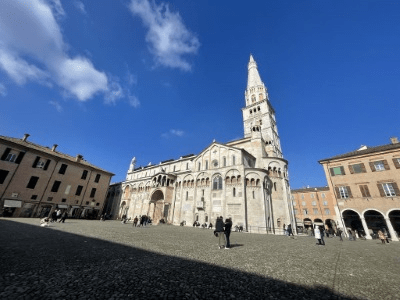
Parma’s Piazza Duomo is of another time. It is empty of all modern comforts and technologies, missing even the awnings and tables of bars that line most Italian city piazze. One imagines hooded monks scurrying across the square to deal with urgent ecumenical business.

The sounds of the ghetto ring from a ragged man’s accordion. The musical mood he sets is of doom and desolation. The brickwork of the cathedral’s tower is unusually striped, with redder streaks piercing the skin-coloured bricks like lacerations from the whip. The Piazza continues to visit violence on you from the other side, where a bulky, swollen palazzo squares up to fight you. Women wearing flowers and veils trudge into the cathedral, heads dipped. Bumpy stones suffice as its floor, making it like walking on a riverbed or hot coals. Do not dash your foot against the stone.
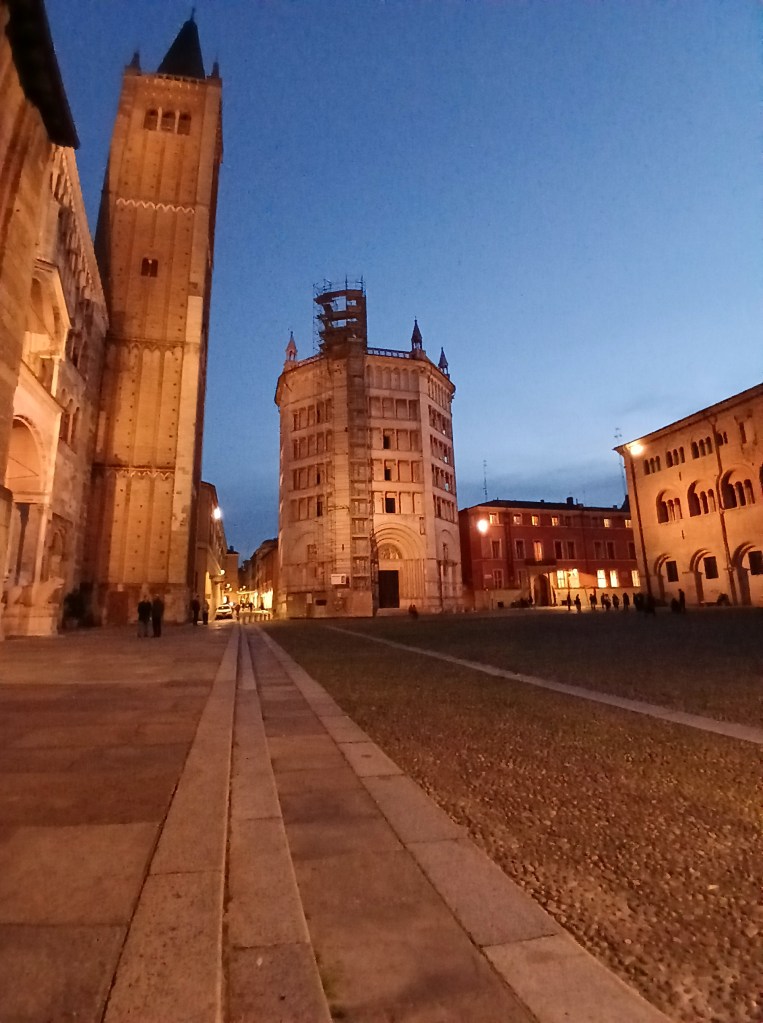
The pagoda-like tower of the battistero presents to the square a towering wall of balconies like an actor would see from an Elizabethan stage. Play to the balcony for your life, it says. These balconies are imposing and unreachable, leaving you exposed and scrutinised in the middle of the square, as though on trial before a menacing clergy lining the balconies of the towering jury box. They intimidate you beneath them on the rocky arena floor. You are baring all the sins of your soul to the hooded figures filling the strata of pulpits, their cascading effect like a helter-skelter illustrating the descent of your spirit under their glaring gaze. To one side, the palazzo acts as henchman and bailiff in this court.

This is the birthplace of Verdi, composer of Dies Irae, and the voices of the damned screaming from hell are heard in this square. Something of a divine visitation is hinted at here in the square as the cathedral displays a bunting advertising ‘la Madonna ritrovata‘. But when she is found again, and perhaps a more severe otherworldly figure along with her, they are not here to bring ascension, but instead to collect debts. God has been keeping receipts and the souls left in Piazza Duomo at nightfall will suffer the eternal flame.

Then shall with universal dread
the Book of Consciences be read
to judge the lives of all the dead.

For now before the Judge severe
all hidden things must plain appear;
no crime can pass unpunished here.

O what shall I, so guilty plead?
and who for me will intercede?
when even Saints shall comfort need?
Finding the sun in Modena

Stillness drapes over Modena. When compared to Bologna, it is an unsettlingly quiet place. When walking the streets it is not obviously smaller or less urban than its big brother city, but you can get lost for half an hour or so in which time you won’t walk past anything.

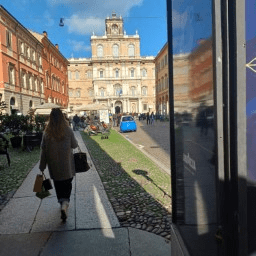
After one of these half hours – the first after the train station – we drifted past a military academy palazzo on a sun-draped piazza. Perfect coffee weather, we said, though cruelly, when we sat outside an ornate bar, a shadow fell and divided the street longways, cloaking us in its chill.

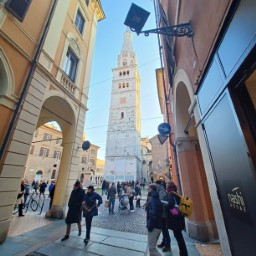
Many of Bologna’s familiar scenes are here too. You can spend half an hour orbiting the piazze on narrow yard-like streets that look just like Via delle Tovaglie or its neighbours in the South of Bologna’s old town. These are murky, musky places where you rarely pass another soul. Narrow lanes with high buildings casting their shade from either side. The walls are yellow with a visible baked ceramic quality. The porticos are often cracked, misaligned, and mismatched, and if you stare down one, they are rarely straight, but usually slink off round an accidental bend. fitting Their floors are sometimes pretty mosaics or patterned tile, but equally often are made of patches of grey concrete slapped-down in a hurry. The frontages of the buildings, hooded in the porticos’ shade, are autumnal-coloured stucco, but the walls are uneven and wonky, taking on the quality of sand dunes whittled and smoothed by wind. These lanes often smell gently of sewage or municipal bins. You are truly alone on these streets, and they invite you to walk slowly, past the signs of nearby human life; the odd parked car or populated washing line are like museum artefacts, only suggesting the presence of life.

We rounded one of these eternal bends for some time, aware that the street was taking us only around where we wanted to go. The sun was out and the sky was a clear and solid blue for the first time since arriving in Italy three weeks earlier. Now was the time for the outdoor seating culture to come into its own. Now was the time for us to finally enjoy an outdoor drink without being swaddled in coats. Now was the time to feel a cool breeze on our faces and savour the mild smells that drift on the air on such bright and temperate days. But where was the sun? The clear blue sky indicated its presence and the walk to Bologna Centrale on the way had been warm and summery. Now, though, the bright clarity of the sky was literally a false dawn, as we shivered through dark porticoes on an endless orbital road. The piazza and the broad boulevards were somewhere to our right the whole time but we circled them helplessly, unable to find a perpendicular street to turn down.

And so, we stood in penumbral spaces for much of the day, and Modena was a story of the sharp edge between shadow and light. We took cold salumi and tortellini in brodo for lunch, itself an instructive contrast of a pair. The cold meats were unsatisfying on this day when I needed a warming and hearty meal. The brodo provided this, but became an emblem for some misconceptions about this part of the country. The food, on the whole, is brothy and hearty, its spirit asking to be served on a tavern’s hearth to sheltering guests. The occluded spaces of the porticoes cast walkers in shade, and the wind through the Po Valley keeps the coats on you longer into the year than you would imagine. This is not sunshine, tomatoes, and basil Italy, but something much more Teutonic. In Modena, our search for the sunlight accompanied this realisation, as the pure blue of the sky could not have been further from the dim of the pavements.

In Modena’s Piazza Grande, the sun finally comes out and warms you. A full sense of timelessness and still now descends as you look at the Duomo’s leaning towers and occluded exterior balconies. You notice the number of people standing still, a sign that there is enough in the place, environmentally and ambiently speaking, that simply standing and diffusing yourself into the atmosphere is enough, and no extraneous ‘activities’ or cumbersome ‘tasks’ are needed.

liminal spaces and dark corners

From the penumbra starts here, a blog about liminal spaces and dark corners. In it you will find writing on any aspect of culture that strikes me and which I can tenuously fit to the rubric of liminal spaces and dark corners. As such, this tagline will serve more as a prompt than a theme. Few if any will read the early posts on the site, perhaps ever, but that’s okay. It will also serve as a home to a portfolio of things I’ve written for other publications. You can find selections of writing on arts and culture, as well as politics and business above, and readers are encouraged to contact me about any past, present, or future work. My nascent Substack, Through a Glass Darkly, can also be reached through the site, though time will tell if it and this blog merge together, or one cannibalises the other. The Substack is about pubs, or, as I prefer to say, things that happen in pubs. There is enough low effort content out there simply describing a pub’s appearance with cheap comments like ‘it has authentic charm’, or worst of all, giving tacky scores and rankings to aspects of a pub. I’m trying to do more with it than that.

As you might imagine, pubs will therefore be a frequent theme on this blog, though pubs are only as interesting as the culture they package up and display to us. Other spaces that crystalise instrumental cultural moments will be a common topic too, therefore, and I doubt I’ll have difficulty contorting my rubric to write about whatever I want in the end.

I say this because the blog starts as I’m living in Bologna, with a marked shortage of pubs, but no dearth of equivalents. Don’t be surprised when posts about Modena and Bologna pop up. These cities are characterised by their dark corners, being renowned for hundreds of miles of porticoes sheltering their pavements. This, I fancy, makes every street in Bologna a liminal space of a dark corner, so this is a perfect time to launch. Expect elements of polemic, psychogeography, and history based on my loose prompts.

To say a little about me, I am Ciarán Donnelly and I’m a journalist. Right now I’m spending most of my time writing for RN magazine and Retail Express – nothing too exciting. This will be where the rest of my stuff goes.