When I think of the Irish West London, I hesitate to call it a ‘community’ because this word implies there is some kind of organised cultural enterprise or shared experience. Rather, I think Irish people in the wider UK can possibly claim the crown of being the blandest, most humdrum immigrants in the eyes of the natives of their adopted country. Part of this might be the erasure or ignorance of the differences between British and Irish culture, and some might be, unfortunately, still the trace of colonial dismissiveness towards the independence of Ireland. Whatever cultural expression can be found, though, the most common by far is music nights in Irish pubs up and down West London.
Irish people in West London are a fairly visible diaspora. From the northern former heartlands of Kilburn and Cricklewood, which are declining in visible Irishness but sweeping down across all of Brent and Ealing and into a Southern nadir in Hounslow, Irish surnames and their owners within two generations of immigrants are everywhere. Many work in construction; just gaze at the names on the side contractors’ vans and you’ll see Conway, Murphy, and O’Donnovan. Check your shoes before you put them for stray Byrnes and Walshes. Rummage down the back of the sofa for loose McCarthys and Ryans.
Most of these places, which I have written a lot about before, have one night a week where virtuosic but amateur musicians bring their instruments, not to perform on a stage, but to sit round a normal pub table with other players they may not know, to hammer out traditional instrumental tunes – known as reels – until very late into the night. Their pay is free pints and a sense of satisfaction.
London centric
Of course, these nights are modelled on nights that happen every day of the week in huge numbers of pubs all over Ireland itself. The London version is usually different to what you see in Ireland, favouring the singalong drinking tunes – usually with some variant of the word ‘rover’ or ‘roving’ in the title – made famous by the Dubliners and Pogues, with some reels sprinkled in. In Ireland, the more traditional reels take precedence and sung songs are rarer.
The London version, however, is a facsimile for those nurtured in the attitudes and opinions of immigrant families. The distance across the sea is not spanned by these music nights and the London version becomes its own organism to express a feeling of displacement and a tenuous relationship to a place that at once you feel attached to but embarrassed to claim as your own because of your accent and experiences.
Over the next week, I’ll be writing about the trad nights of West London. In keeping with the theme of this blog, they are penumbral; not at the centre of anything, neither of London culture or its pub milieu, nor the musical culture of Ireland itself from which it draws its life blood.
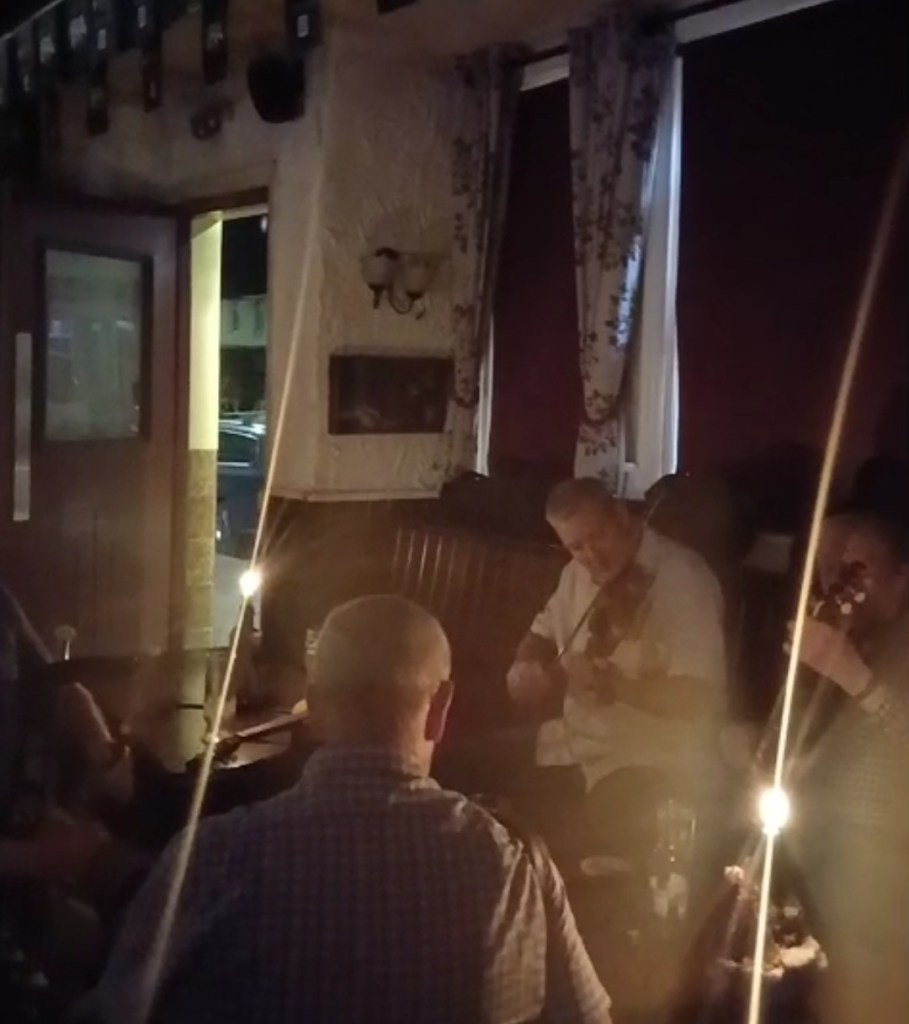
 from the penumbra